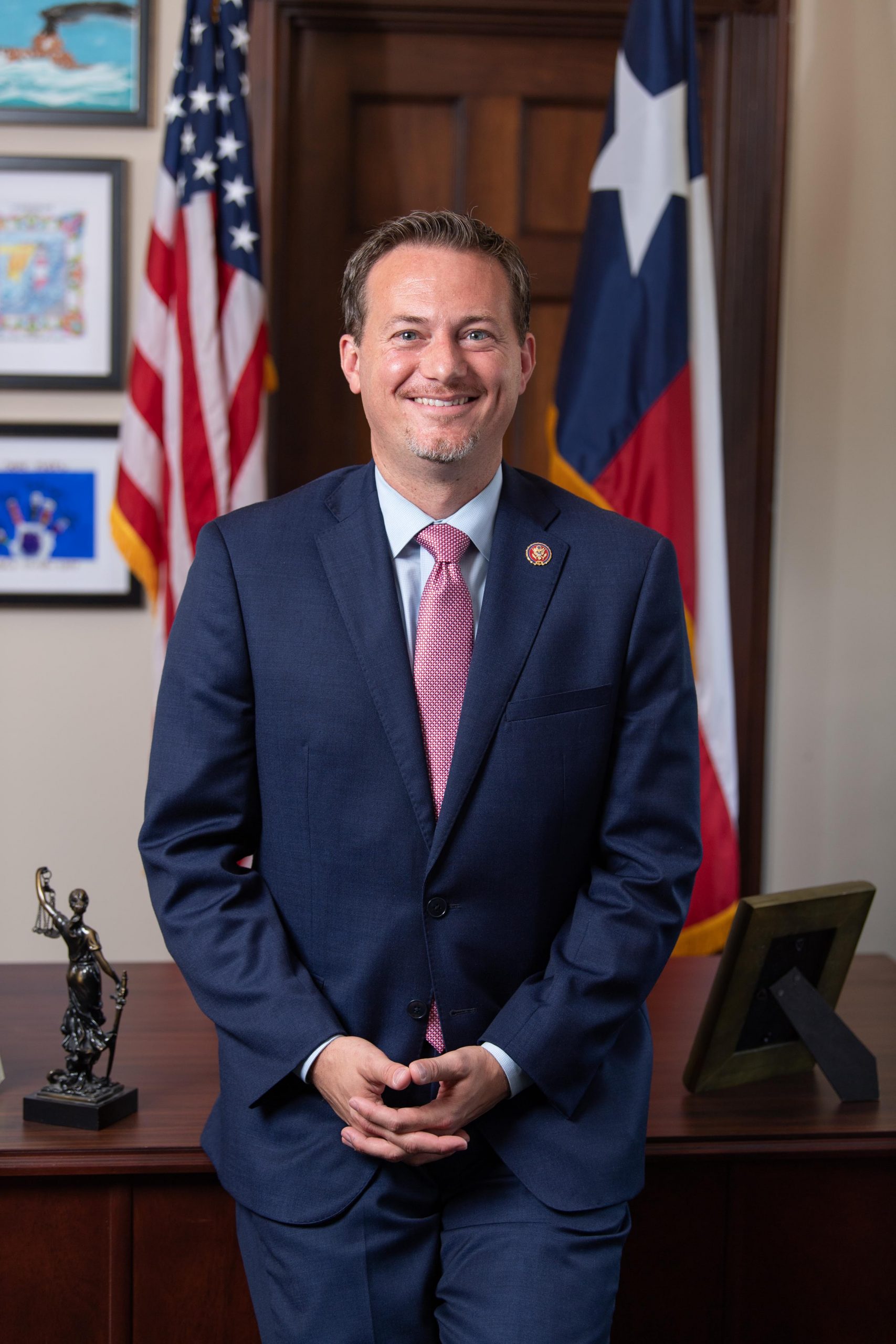
Michael Cloud
RU.S. Representative · Texas-27 · 115th-119th, 8 years 2 months
BillHouseIntroduced
U.S. House of Representatives·Introduced Sep 10, 2026·Sep 10, 2026 — Referred to the Committee on Rules, and in addition to the Committee on the Budget, for a period to be subsequently determined by the Speaker, in each case for consideration of such provisions as fall within the jurisdiction of the committee concerned.
Economics and Public FinanceD3R17(20 co-sponsors)DRBipartisan
Introduced
Cost Estimates Improvement ActThis bill requires cost estimates prepared by the Congressional Budget Office or the Joint Committee on Taxation to include the costs of servicing the public debt.
BillHouseIntroduced
U.S. House of Representatives·Introduced Aug 6, 2026·Aug 6, 2026 — Referred to the House Committee on Armed Services.
Armed Forces and National Security
Introduced
This bill allows the Secretary of Defense to write off accounting charges and internal debts at Defense Department depots and arsenals when capital assets stop generating revenue due to mission changes ordered by the federal government. The legislation specifically targets depreciation costs and internal Department debts associated with equipment or facilities that are no longer being used for their original purpose, which can happen when the military realigns its operations. The authority applies only to internal accounting matters within Defense Department accounts and does not affect payments owed to outside contractors. The bill requires that any previous cash spent from revolving funds be recovered before eliminating these accounting charges. The Secretary of Defense can delegate this authority to individual military department secretaries to carry out the write-offs.
BillHouseIntroduced
U.S. House of Representatives·Introduced Aug 6, 2026·Aug 6, 2026 — Referred to the House Committee on Armed Services.
Armed Forces and National SecurityD1R0(1 co-sponsor)
Introduced
The Depot Data Transparency Act modifies an existing federal requirement for annual reporting on military depot maintenance work. Currently, the Department of Defense must report on how maintenance work is split between public and private sector facilities, but the bill requires these reports to now include specific dollar amounts spent and projected to be spent at each individual depot facility. This change affects the Department of Defense and its various agencies that oversee military maintenance depots across the country. The legislation has no specified funding mechanism or timeline beyond requiring the modified reporting going forward. The bill essentially increases transparency by requiring the Defense Department to break down maintenance spending by individual facility rather than reporting only percentages and aggregate figures.
BillHouseIntroduced
U.S. House of Representatives·Introduced Aug 3, 2026·Aug 3, 2026 — Referred to the House Committee on Financial Services.
Finance and Financial SectorD0R33(33 co-sponsors)
Introduced
This bill would permanently ban the Federal Reserve and its regional banks from issuing or creating a central bank digital currency, commonly known as a CBDC. The legislation modifies the Federal Reserve Act to remove provisions that currently allow for CBDC development and explicitly prohibits the Federal Reserve from pursuing this form of digital money. The bill affects the Federal Reserve's monetary policy authority and any plans it may have had to create a digital version of the U.S. dollar. There is no specific funding mentioned in the legislation, and the ban would take effect upon enactment with no sunset date or expiration timeline. The bill was introduced in August 2026 by a group of House Republicans and referred to the Committee on Financial Services.
ResolutionHouseIntroduced
U.S. House of Representatives·Introduced Jul 20, 2026·Jul 20, 2026 — Referred to the House Committee on Rules.
Congress
Introduced
This House resolution expresses the opinion that the Senate's filibuster and cloture rules contradict the Constitution's design and should be reformed or eliminated. The resolution argues that the Framers intended both chambers of Congress to operate as co-equal majoritarian bodies where legislation passes by simple majority vote, and cites the Constitution, Federalist Papers, and Supreme Court precedent to support this view. It claims the modern filibuster—which allows 41 senators to block a vote without debate—prevents House-passed legislation from receiving Senate consideration, undermines the deliberative process, and effectively disenfranchises House members and their constituents by nullifying their legislative work. The resolution calls on the Senate to reform its rules to ensure that legislation receives floor votes determined by majority rule, while still allowing minorities to debate and propose amendments. This is a non-binding expression of House sentiment with no direct legal effect; it requires only transmission to Senate leadership and members.
BillHouseIntroduced
U.S. House of Representatives·Introduced Jun 18, 2026·Jun 18, 2026 — Referred to the House Committee on Energy and Commerce.
Health
Introduced
The Medicaid Equal Standards Act would require states to implement an asset test for people newly eligible under Medicaid expansion, meaning individuals would need to have resources below a certain threshold to qualify for coverage. Starting in 2029, the base asset limit would be set at $10,000 per person (or $20,000 for married couples), with this amount adjusted every four years based on inflation. States would have flexibility to set their own lower limits or count additional assets that are normally excluded from such tests, and these decisions would not require federal approval. The bill targets the expansion population—individuals who became eligible for Medicaid under the Affordable Care Act—and would not affect eligibility for other Medicaid groups or reduce federal matching payments to states based on asset test denials.
ResolutionHouseIntroduced
U.S. House of Representatives·Introduced Jun 15, 2026·Jun 15, 2026 — Referred to the House Committee on Rules.
Congress
Introduced
This is a House resolution expressing opposition to the Senate's filibuster and cloture rules. The resolution argues that these procedural rules contradict the Constitution's design for two co-equal chambers operating under majority rule, citing the Framers' intent as demonstrated in the Federalist Papers and Constitutional Convention records. According to the resolution, the modern filibuster—which allows 41 senators to block legislation without debate or a floor vote—is not deliberative and prevents House-passed bills from receiving Senate consideration on their merits. The resolution also contends that the filibuster effectively disenfranchises House members and their constituents by nullifying majority votes without substantive Senate disagreement. The resolution calls on the Senate to reform or eliminate filibuster rules to ensure House-passed legislation receives timely floor votes decided by a Senate majority, while preserving minority rights to debate and offer amendments. The House Clerk is directed to transmit the resolution to Senate leadership and all senators.
BillHouseIntroduced
U.S. House of Representatives·Introduced May 4, 2026·May 4, 2026 — Referred to the House Committee on Energy and Commerce.
Commerce
Introduced
The "You Own the Data Act" (YODA) is a comprehensive data privacy bill that establishes consumers' legal ownership of their personal information and restricts how technology companies and data brokers can collect, use, and sell that data. The legislation prohibits companies from requiring users to share their personal data or contacts as a condition of using services, mandates that companies delete browsing history and biometric data within 60 days of collection, and requires companies to provide users with free access to their data within 90 days of request, along with the ability to correct, delete, or port that data. The bill applies to large technology companies and data brokers with significant U.S. user bases or revenues, and it grants enforcement authority to the Federal Trade Commission and state attorneys general, while also allowing individuals to sue companies for violations and recover between $100 and $750 per violation plus attorney's fees. Additionally, the law requires clear privacy notices, prohibits tracking cookies without consent, mandates annual reports on data sharing, and provides special protections for minors under 18 years old.
BillHouseIntroduced
U.S. House of Representatives·Introduced Feb 9, 2026·Feb 9, 2026 — Referred to the House Committee on the Judiciary.
Sports and RecreationD0R17(17 co-sponsors)
Introduced
This bill requires U.S. national sports governing bodies to establish eligibility rules for Olympic and other sanctioned competitions that limit participation to events matching an athlete's biological sex at conception. The legislation defines "male" and "female" based on reproductive biology and applies to the Olympic Games, Paralympic Games, Pan-American Games, and other competitions sanctioned by national governing bodies. The bill also requires these organizations to continue sanctioning single-sex athletic competitions that they previously sanctioned in the 10 years before the law's enactment and prevents them from changing the sex categories of existing events, except to comply with this new requirement. The legislation does not prevent governing bodies from creating mixed-sex competitions. There is no specific funding mechanism or implementation timeline specified in the bill beyond its date of enactment.
BillHouseIntroduced
U.S. House of Representatives·Introduced Oct 24, 2025·Oct 24, 2025 — Referred to the House Committee on Energy and Commerce.
HealthD0R18(18 co-sponsors)
Introduced
H.R. 5815 would adjust the federal funding rate for Medicaid in Washington, D.C., beginning immediately at 70 percent federal coverage and then phasing down gradually through 2029. Currently, D.C. receives a higher federal matching rate than most states under Medicaid law; this bill would reduce that advantage by setting a ceiling of 70 percent starting now and decreasing to 55 percent by fiscal year 2029. After 2029, D.C. would receive whatever lower rate it qualifies for under standard Medicaid formulas. The legislation affects D.C.'s Medicaid program and the residents who rely on it for health coverage, as it would reduce federal funding available to support the program. The bill includes a transition period of roughly four years to phase in the changes, though it does not specify total dollar amounts affected by these reductions.
BillHouseIntroduced
U.S. House of Representatives·Introduced Oct 24, 2025·Oct 24, 2025 — Referred to the House Committee on Energy and Commerce.
EnergyD0R10(10 co-sponsors)
Introduced
The Natural Gas Export Expansion Act amends federal law to streamline the approval process for exporting natural gas to most countries around the world. The bill removes certain regulatory requirements and creates an expedited approval pathway, with the goal of increasing domestic natural gas production, investment, and job growth. The legislation maintains safeguards by excluding nations under U.S. sanctions and allowing the President or Congress to block exports to additional countries on national security grounds. It also eliminates approval requirements for natural gas trade with Canada and Mexico. The bill contains no specific funding allocations or implementation timelines, instead focusing on regulatory changes to existing export authorization procedures.
ResolutionHouseIntroduced
U.S. House of Representatives·Introduced Sep 18, 2025·Sep 18, 2025 — Referred to the House Committee on Education and Workforce.
FamiliesD0R4(4 co-sponsors)
Introduced
H.Res. 735 is a symbolic resolution that designates July as "American Families Month" to recognize the importance of families, particularly stably married nuclear families, in American society. The resolution does not create any new laws or programs, nor does it include any funding or specific timelines for implementation—it is instead a statement of support from the House of Representatives. The resolution emphasizes sociological research suggesting that family stability contributes to positive outcomes for children, stronger communities, and broader economic prosperity, while expressing concern about declining marriage rates. By supporting this designation, the resolution calls for policies that strengthen nuclear families and remove barriers to family formation, though it does not specify what those policies would be. This resolution affects the general public by promoting awareness and discussion about the role of stable families in American life.
BillHouseIntroduced
U.S. House of Representatives·Introduced Sep 18, 2025·Sep 18, 2025 — Referred to the House Committee on Rules.
CongressD0R3(3 co-sponsors)
Introduced
H.R. 5459 would move up Congress's summer break by roughly one month. The bill amends the 1946 Legislative Reorganization Act to change the deadline for the congressional summer adjournment from July 31 to June 30, and shifts the recess period from early September (around Labor Day) to early August. This means Congress would need to finish its work and leave for summer break earlier in the year, and return earlier in the fall. The changes would take effect when the second session of the current Congress (the 119th) begins, likely in early 2026. The bill does not specify any new funding or create substantial budgetary changes.
Joint ResolutionHouseIntroduced
U.S. House of Representatives·Introduced Sep 2, 2025·Sep 2, 2025 — Referred to the House Committee on Oversight and Government Reform.
Government Operations and PoliticsD0R23(23 co-sponsors)
Introduced
H.J. Res. 118 is a symbolic resolution expressing congressional support for designating September 12 each year as "The Day of the Bible" in the United States. The bill commemorates September 12, 1782, when Congress approved publication of the first complete English-language Bible printed in America, known as the Aitken Bible. The resolution encourages schools, civic institutions, and community organizations to observe the day with educational and cultural programs highlighting the Bible's historical significance to the nation, and it directs the President to issue an annual proclamation for the observance. This is a non-binding symbolic measure that does not create any new government programs, funding requirements, or legal obligations—it simply expresses Congress's support for the designation and encourages voluntary participation by institutions and the public.
ResolutionHouseIn Committee
U.S. House of Representatives·Introduced Jul 29, 2025·Jul 30, 2025 — Referred to the Subcommittee on Coast Guard and Maritime Transportation.
Transportation and Public WorksD8R9(17 co-sponsors)DRBipartisan
Committee
This resolution commends the Coast Guard for its courageous and swift response to the July 2025 flooding disaster in Texas.It also extends gratitude to all of the federal, state, and local first responders and volunteers who responded to this tragedy.
BillHouseIn Committee
U.S. House of Representatives·Introduced Mar 21, 2025·Mar 25, 2025 — Ordered to be Reported (Amended) by the Yeas and Nays: 23 - 21.
Government Operations and PoliticsD0R1(1 co-sponsor)
Committee
This bill gives the President the power to terminate or override provisions in federal employee union contracts that conflict with presidential orders, rules, or executive directives. The authority applies only to a newly inaugurated President when they first take office and cannot be used by an incumbent President during their term. When a union contract conflicts with any presidential action—such as an executive order or memorandum—that provision becomes unenforceable, as determined by the President or agency head. The bill requires agencies to notify the relevant union in writing whenever they terminate contract provisions or identify conflicts. The legislation amends federal labor law (Title 5, Chapter 71) and does not include specific funding or implementation timelines beyond the requirement for written notification.
BillHouseIn Committee
U.S. House of Representatives·Introduced Mar 11, 2025·Mar 11, 2025 — Referred to the Subcommittee on Economic Development, Public Buildings, and Emergency Management.
Emergency ManagementD0R36(36 co-sponsors)
Committee
Protecting the Right to Keep and Bear Arms Act of 2025This bill prohibits (1) the President or the Department of Health and Human Services from declaring emergencies or disasters for the purpose of imposing gun control; and (2) a federal officer or employee, or person operating under color of federal law or receiving federal funds, from banning the possession, manufacture, sale, or transfer of weapons to which the Second Amendment of the Constitution applies, ammunition, or firearm accessories while acting in support of relief from a major disaster or emergency.
BillHouseIntroduced
U.S. House of Representatives·Introduced Mar 10, 2025·Mar 10, 2025 — Referred to the House Committee on Oversight and Government Reform.
Government Operations and PoliticsD0R1(1 co-sponsor)
Introduced
The Return to Sender Act would rescind and repeal unspent federal funding that was authorized under two specific sections (70002 and 70003) of the Inflation Reduction Act, which was enacted in 2022. Any money appropriated under these sections that has not yet been committed to specific projects or obligations would be cancelled and removed from agency budgets. The bill does not specify the dollar amount of unobligated funds targeted, nor does it identify which agencies or programs would be affected. The legislation was introduced in March 2025 and referred to the House Committee on Oversight and Government Reform. This is a straightforward budget rescission bill with no new funding authorized and an effective date of enactment.
BillHouseIn Committee
U.S. House of Representatives·Introduced Feb 27, 2025·Feb 27, 2025 — Referred to the Subcommittee on Economic Development, Public Buildings, and Emergency Management.
Emergency ManagementD0R10(10 co-sponsors)
Committee
End FEMA Benefits for Illegal Immigrants ActThis bill prohibits the Federal Emergency Management Agency (FEMA) from carrying out the Shelter and Services Program (SSP) and rescinds unobligated funds transferred to FEMA for this purpose for FY2023-FY2024. The SSP provides grants to public and nonprofit entities for temporarily providing shelter and other services (e.g., food, transportation) to noncitizen migrants released from Department of Homeland Security custody and awaiting immigration court proceedings, as well as for increasing grant recipients’ capacity to temporarily shelter such individuals (e.g., modifying existing facilities).
BillHouseIntroduced
U.S. House of Representatives·Introduced Feb 26, 2025·Feb 26, 2025 — Referred to the Committee on Oversight and Government Reform, and in addition to the Committee on Ways and Means, for a period to be subsequently determined by the Speaker, in each case for consideration of such provisions as fall within the jurisdiction of the committee concerned.
Government Operations and PoliticsD1R3(4 co-sponsors)DRBipartisan
Introduced
Dismantling Investments in Violation of Ethical Standards through Trusts ActThis bill prohibits a senior federal employee or an employee's spouse or dependent children from holding, purchasing, or selling certain financial instruments during the employee's term of service. (A senior federal employee is defined as any individual occupying a Senior Executive Service position.)Financial instruments covered by this prohibition include any investments in securities, security futures, commodities, or comparable economic interests acquired through synthetic means such as the use of derivatives. The prohibition does not apply to such instruments if they are held in a qualified blind trust or fall below certain value thresholds. Additionally, the prohibition does not apply to diversified mutual funds, diversified exchange-traded funds, specified Treasury debt securities, or compensation from the primary occupation of a spouse or child. The bill provides a 180-day window for individuals affected by the bill to sell any prohibited financial instruments.Any profit made in violation of the prohibition must be disgorged (given) to the Treasury and may subject the individual to a civil fine assessed by the supervising ethics office. A loss from a transaction or holding conducted in violation of this bill may not be deducted from the amount of income tax owed by the applicable senior federal employee, spouse, or dependent child.The bill requires each senior federal employee to annually certify compliance, including the compliance of the employee's spouse and dependent children. The Government Accountability Office must conduct a compliance audit.
BillHouseIntroduced
U.S. House of Representatives·Introduced Feb 5, 2025·Feb 5, 2025 — Referred to the Committee on Rules, and in addition to the Committee on the Budget, for a period to be subsequently determined by the Speaker, in each case for consideration of such provisions as fall within the jurisdiction of the committee concerned.
Economics and Public FinanceD3R17(20 co-sponsors)DRBipartisan
Introduced
Cost Estimates Improvement ActThis bill requires cost estimates prepared by the Congressional Budget Office or the Joint Committee on Taxation to include the costs of servicing the public debt.
BillHouseIn Committee
U.S. House of Representatives·Introduced Feb 5, 2025·Feb 5, 2025 — Referred to the Subcommittee on Highways and Transit.
ImmigrationD0R19(19 co-sponsors)
Committee
Preventing Aliens Through Rivers or Land Act or the PATROL ActThis bill prohibits the Department of Justice (DOJ) from bringing certain civil actions against a state for building a physical structure impacting navigable waters along the U.S. border for security purposes. Specifically, the DOJ is prohibited from bringing an action for (1) the construction of a bridge, causeway, dam, dike, or other structure over or in a port, harbor, or other navigable water of the United States without federal approval; or (2) the creation of any obstruction to the navigable capacity of waters of the United States without federal approval.
BillHouseIn Committee
U.S. House of Representatives·Introduced Feb 4, 2025·Feb 4, 2025 — Referred to the Committee on Oversight and Government Reform, and in addition to the Committees on the Judiciary, Education and Workforce, Armed Services, Foreign Affairs, Financial Services, Energy and Commerce, Transportation and Infrastructure, and Intelligence (Permanent Select), for a period to be subsequently determined by the Speaker, in each case for consideration of such provisions as fall within the jurisdiction of the committee concerned.
Civil Rights and Liberties, Minority IssuesD0R109(109 co-sponsors)
Committee
H.R. 925, the Dismantle DEI Act of 2025, revokes seven executive orders and two national security memoranda related to federal diversity and racial equity initiatives, effective immediately upon enactment. The bill requires all federal agencies to close their diversity, equity, inclusion, and accessibility (DEI) offices within 90 days and lay off affected employees without reassigning them to other positions, though Equal Employment Opportunity and Americans with Disabilities Act enforcement offices are exempted. The legislation also prohibits "diversity, equity, and inclusion practices" in any federal programs or activities that receive federal funding, with enforcement mechanisms similar to those used for civil rights discrimination violations. Agency heads must establish compliance guidelines and monitoring systems to enforce these restrictions across their departments. If any portion of the law is found unconstitutional, the remaining provisions will continue in effect.
BillHouseIntroduced
U.S. House of Representatives·Introduced Jan 31, 2025·Jan 31, 2025 — Referred to the House Committee on the Judiciary.
Government Operations and PoliticsD0R7(7 co-sponsors)
Introduced
No Regulation Through Litigation Act of 2025This bill specifies that a federal agency may not enter into a consent decree that exceeds the authority of the court that enters the order related to the decree. It also limits the inclusion of attorney fees or litigation costs in consent decrees or settlement agreements that result in a regulation or guidance document.
BillHouseIntroduced
U.S. House of Representatives·Introduced Jan 31, 2025·Jan 31, 2025 — Referred to the Committee on Ways and Means, and in addition to the Committee on the Judiciary, for a period to be subsequently determined by the Speaker, in each case for consideration of such provisions as fall within the jurisdiction of the committee concerned.
Crime and Law EnforcementD0R18(18 co-sponsors)
Introduced
Silencers Help Us Save Hearing Act or the SHUSH ActThis bill removes silencers from regulation under certain federal statutes governing the sale, transfer, and possession of firearms.Specifically, it removes silencers from the list of firearms subject to regulation (i.e., registration and licensing requirements) under the National Firearms Act (NFA). Additionally, it excludes a muffler or silencer from the list of firearms subject to regulation (e.g., background check requirements) under the Gun Control Act of 1968 (GCA).Finally, the bill does the following:preempts state or local laws that tax or regulate firearm silencers,specifies that a person who lawfully acquires or possesses a silencer under provisions of the GCA meets the registration and licensing requirements of the NFA,eliminates mandatory minimum prison terms for a crime of violence or drug trafficking offense in which a defendant uses or carries a firearm equipped with a silencer or muffler, andpermits active and retired law enforcement officers to carry a concealed silencer.